
When we think about the founding of America, we often picture dramatic moments like the signing of the Declaration of Independence or George Washington crossing the Delaware. But some of the most crucial work was quite hush hush—in shadows and secrecy. My favorite hidden history? The Continental Congress maintained not one, but two sets of official records during the Revolutionary War. The public journals for the Crown told one story. The “Secret Journals” told another entirely.
Charles Thomson: America’s Keeper of Secrets
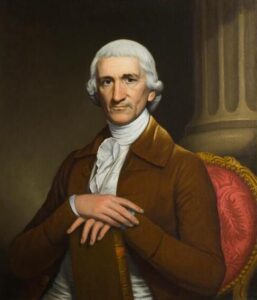
Charles Thomson served as the only Secretary of the Continental Congress for its entire fifteen-year existence, from 1774 to 1789. While delegates came and went, Thomson remained the constant presence, faithfully recording debates and decisions that would shape the infant nation. His name was regarded as an emblem of truth, and in all the factional disputes of the Revolutionary period, his judgment was respected.
But Thomson held a responsibility that went far beyond typical record-keeping. He was trusted to decide which minutes of their meetings and decisions were recorded in the Secret Journal. This wasn’t just administrative discretion—it was a matter of life and death during wartime.
Why Two Sets of Books?
The Continental Congress faced an impossible situation. As rebels fighting against the British Crown, they were technically committing treason with every decision they made. Yet they also needed to govern, conduct diplomacy, and coordinate military efforts. The Continental Congress, recognizing the need for secrecy regarding foreign intelligence, foreign alliances, and military matters, maintained “Secret Journals,” apart from its public journals, to record its decisions in such matters.
And yes—they actually called them the “Secret Journals.” Not the “Confidential Records” or “Classified Documents” or some other euphemistic title. Just the Secret Journals. The straightforward name tells us everything about the founders’ mindset: they knew they were doing dangerous work, and they weren’t going to pretend otherwise.
The public journals served multiple purposes. They kept colonists informed about congressional actions and demonstrated legitimacy to both supporters and skeptics. But they were also sent to Britain as required communications from what the Crown still considered its colonial assemblies.
The Secret Journals, however, contained the real business of revolution. Congress recorded all decisions regarding the Committee of Secret Correspondence in “Secret Journals”, separate from the public journals used to record decisions concerning other matters. These confidential records documented intelligence operations, foreign negotiations, covert supply chains, and military strategies that would have meant execution for anyone involved if discovered by British forces.
What the Continental Congress Secret Journals Contained
The scope of activities hidden in these journals was remarkable. The committee employed secret agents abroad, conducted covert operations, devised codes and ciphers, funded propaganda activities, authorized the opening of private mail, acquired foreign publications for analysis, established courier systems, and developed maritime capabilities apart from the Continental Navy.
The Secret Journals covered the period from 1775-88 and included sensitive intelligence operations and foreign negotiations. They documented everything from arms procurement in France to intelligence gathering about British troop movements. The journals also contained records of financial arrangements that couldn’t be made public—payments to spies, funding for covert operations, and contracts with suppliers who needed anonymity for their own protection.
On November 9, 1775, the Continental Congress adopted its oath of secrecy, one more stringent than the oaths of secrecy it would require of others in sensitive employment. This wasn’t theatrical politics—it was survival.
The Weight of Secrets
Thomson’s role required incredible discretion and judgment. He had to determine which congressional decisions could safely appear in public records and which needed to remain hidden. After leaving office, he chose to destroy a work of over 1,000 pages that covered the political history of the American Revolution, stating his desire to avoid “contradict[ing] all the histories of the great events of the Revolution”.
This destruction of records represents one of American history’s great mysteries. What did Thomson know that he felt needed to remain buried? His decision to preserve the myths and legends of the Revolution rather than reveal the messy, complicated truth shows how heavy the burden of these secrets became.
The Secret Journals weren’t published until 1821, more than thirty years after the Continental Congress disbanded. None of the contemporary editions included the “Secret Journals” (confidential sections of the records), which were not published until 1821. By then, most of the original participants were dead, and the new nation was strong enough to handle the truth about its covert beginnings.
From History to Fiction: A Novelist’s Discovery
When I was researching Carrying Independence, I knew my protagonist Nathaniel needed a cover story for his mission. I had already named him Nathaniel Marten, choosing his German-based name by reviewing birth/death/marriage records in the Pennsylvania area for the mid-1700s (nearly 1/3 of PA citizens were German).
During my deep dive on the Continental Congress Secret Journal entries, one particular entry caught my attention—a resolution about contracting with a “Mr. Mirtle” for importing goods. The language was formal, vague, and clearly designed to hide the true nature of whatever operation was being authorized.
The Declaration of Independence being engrossed,
and compared at the table, was signed by the members.
Resolved, That the secret committee be empowered to contract with
Mr. Mirtle for the importation of goods to the amount of thirty thousand
pounds sterling, at his risk, and fifteen thousand pounds sterling
at the risk of the United States of America, for the publick service.
That the marine committee be empowered to purchase a swift sailing vessel
to be employed by the secret committee in importing said goods.
Then I realized something incredible: Marten and Mirtle are both derived from Mars, the Roman god of war. My fictional character’s name and the name in this entry were a perfect historical coincidence. I could use this to give Nathaniel exactly what he needed for such a secret mission. An alias.
This discovery shaped how I wrote Chapter 14. I used the exact format and language style of authentic Secret Journal entries but inserted my fictional “carrying committee” and the mysterious Mr. Mirtle contract. The entry in the novel reads exactly like the real thing because it follows the actual patterns Thomson used when recording sensitive operations.
The beauty of historical fiction lies in these moments where research and imagination intersect. By grounding fictional elements in authentic historical practices, the story gains credibility while honoring the real experiences of people who lived through these extraordinary times. (It also allowed me to bring in the notion of Nathaniel taking the sailing vessel referenced here. Later in the novel, he hops on the ship The Frontier featuring a new fictional character—and one of my favorites—Captain Hugo Blythe.)
When Secrets Finally Came to Light
For decades after the Revolution, the Secret Journals remained exactly that—secret. The Continental Congress disbanded in 1789, but the confidential records stayed locked away. It wasn’t until 1821, more than thirty years later, that these hidden chapters of American history were finally published by Thomas B. Wait in Boston under the official title “Secret Journals of the Acts and Proceedings of Congress, From the First Meeting Thereof to the Dissolution of the Confederation.”
The timing wasn’t accidental. By 1821, most of the original participants were dead, and the United States was strong enough to handle revelations about its covert beginnings. The published Secret Journals revealed a four-volume treasure trove of intelligence operations, foreign negotiations, and military strategies that had been hidden from British eyes during the war.
Today, curious readers can explore these fascinating documents themselves through digital archives. The complete Secret Journals are available online, offering an unvarnished look at how the founders really operated when they thought no one would ever know.
Legacy of the Secret Journals
The Secret Journals remind us that the founding of America wasn’t just about grand speeches and dramatic declarations. It was also about intelligence networks, covert operations, and the countless unnamed individuals who risked everything to make independence possible. For years, Thomson’s brain held the best record of what really happened in the Continental Congress.
These hidden records shaped American independence in ways we’re still discovering today. They reveal the Continental Congress as a sophisticated operation that understood the complexities of 18th-century geopolitics. The founders weren’t just idealistic rebels—they were strategic thinkers who built an intelligence apparatus that helped secure victory against the world’s most powerful empire.
The next time you read about the Revolutionary War, remember that for every public resolution passed by the Continental Congress, there may have been secret decisions recorded in Thomson’s careful handwriting. Some of those secrets changed the course of history. Others remain buried forever.
Read the full novel, Carrying Independence, by purchasing an autographed copy. This deep dive focuses on chapter 14 of the novel, which I am serializing for America250 via substack—read for free.
PS: A Secret Journal Entry about Women in the Revolution
While researching the Continental Congress Secret Journals, I stumbled upon another entry that perfectly illustrates how these records captured the human side of the Revolution. On page 804 of the Journals, there’s a matter-of-fact entry about reimbursing Mary House—the same innkeeper whose boarding house sheltered James Madison and other Virginia delegates—for “boarding and funeral expenses of General Du Coudray, deceased.”
General Philippe Charles Tronson du Coudray had been appointed “Inspector General of Ordnance and Military Manufactories” in August 1777, but
died shortly after arriving in America. Congress quietly reimbursed Mary House $400 for his board and lodging, plus $137 for “sundries furnished for the funeral”—a total of $537. The entry sits between payments for paper-making supplies and engraving work, as routine as any other congressional expense.
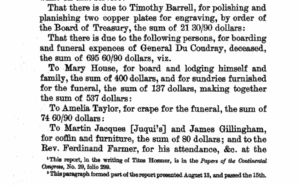
This small entry reveals something profound about the Revolutionary War experience. Behind every grand military appointment and strategic decision were real people—innkeepers like Mary House who opened their homes to foreign volunteers, provided comfort in their final days, and handled the practical necessities when death arrived unexpectedly. Mary House and her daughter Eliza Trist represent the countless women who supported the Revolution in ways that rarely made it into official histories. I proved Mary House as a new female Patriot for the DAR as part of my work on Eliza Trist’s life and journals, and entries like this in the Secret Journals provide rare glimpses into their vital contributions.
The Secret Journals captured these human moments alongside the covert operations, reminding us that the Revolution was fought and supported by ordinary people doing extraordinary things.
#AmericanRevolution #ContinentalCongress #CharlesThomson #SecretJournals #DeclarationOfIndependence #RevolutionaryWar #America250 #HistoricalFiction #FoundingFathers #CarryingIndependence