
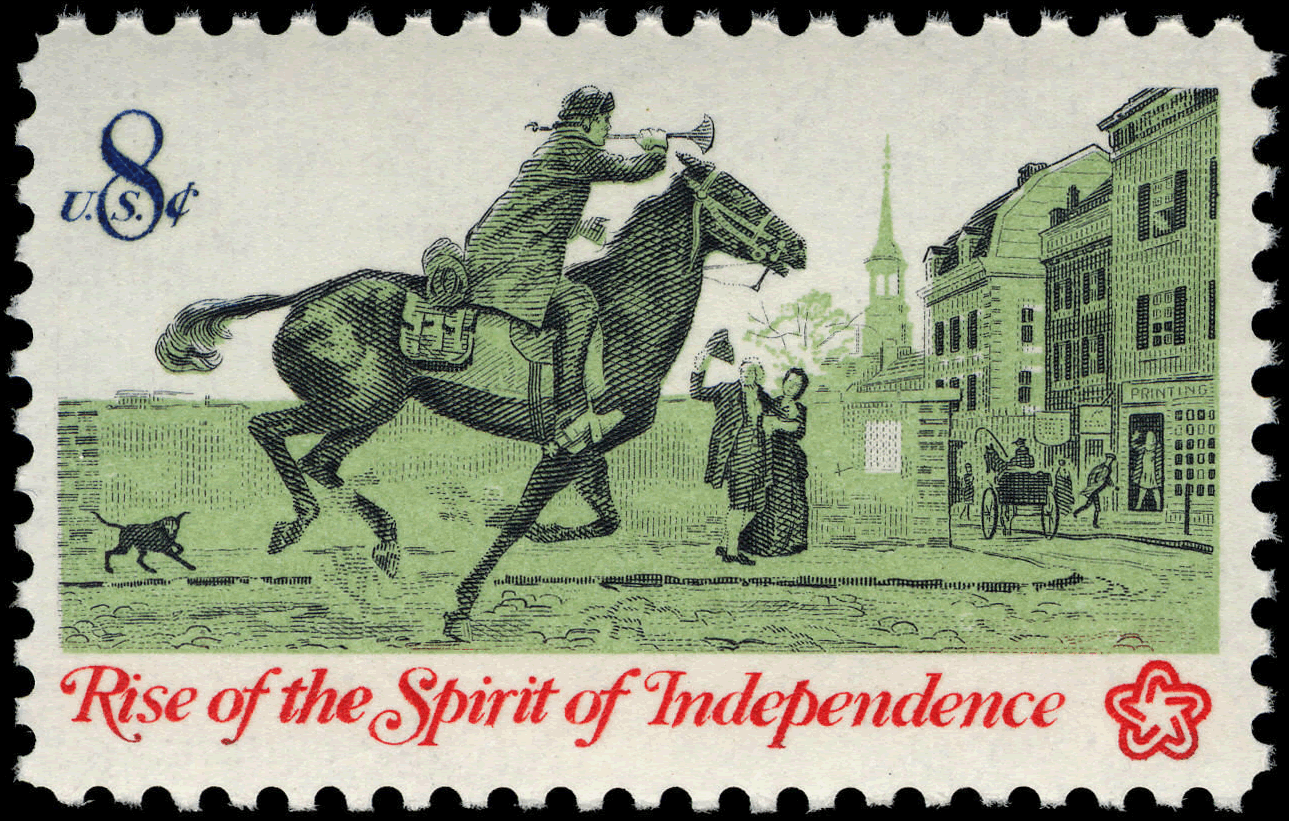
This post corresponds with Chapter 4 of Carrying Independence—serialized for FREE on my substack.
When I was researching locations for Carrying Independence, I needed a protagonist who could believably navigate the treacherous colonial post roads of 1776 while carrying the most important document in American history. That’s when I discovered Berks County, Pennsylvania—one of the few counties without its own post office, making it the perfect home for an express rider like Nathaniel Marten who knew every twist and turn of the colonial post roads. But how did those roads come to be a part of our colonial postal system?
Why Some Counties Went Without Post Offices
In 1776, the colonial postal system was still developing under Benjamin Franklin’s guidance as Postmaster General. Counties like Berks relied on express riders because establishing post offices required sufficient population density, reliable local leadership, and most importantly, enough mail volume to justify the expense. Rural counties often depended on traveling riders who knew every trail, creek crossing, and safe haven along their routes.
The National Postal Museum in Washington, D.C. houses fascinating exhibits about these early postal pioneers, including an impressive leather portmanteau from the colonial era—one of the earliest mail carriers in their collection. While express riders typically used linen haversacks for regular mail delivery, riders carrying precious cargo like Nathaniel often switched to more durable leather bags that could better protect vital documents from rain, river crossings, and the general hazards of wilderness travel.

From Footpaths to Superhighways
What makes the colonial post roads truly remarkable is their lasting impact on American infrastructure. Franklin’s postal survey teams carefully mapped routes that balanced efficiency with safety, creating pathways that would endure for centuries. The Boston Post Road, which connected Boston to New York, forms much of today’s Route 1. Similarly, the Great Indian Warpath through Virginia became portions of Interstate 81.
These weren’t random trails—they were strategically planned networks. Post riders marked trees with axe blazes to guide future travelers, creating the first standardized highway system in America. When you drive I-95 today, you’re following routes first traveled by riders carrying letters between distant colonies, slowly stitching together what would become the United States. You can view a full-size zoomable map of the below 1796 Post Roads map from Bradley is here, online at the Library of Congress map collection.

The Skills That Made Express Riders Essential
Express riders needed extraordinary skills that went far beyond simply staying in the saddle. They had to read weather patterns, navigate by stars, identify safe river crossings, and maintain their horses’ health across hundreds of miles. Most importantly, they needed to be absolutely trustworthy—colonial merchants, political leaders, and families depended on them to deliver everything from business contracts to love letters.
In Carrying Independence, Nathaniel’s background as an express rider makes him uniquely qualified for his ultimate mission. His knowledge of post roads, his ability to survive in the wilderness, and his understanding of how to avoid detection all stem from his experience carrying mail through the Pennsylvania countryside.
Franklin’s Revolutionary Postal Vision
Benjamin Franklin revolutionized colonial mail service, but perhaps not in the way you might expect. As curator Daniel Piazza from the National Postal Museum explains in a fascinating Smithsonian article, the British crown originally established the colonial postal system without any intention of fostering resistance. However, “with the development of a postal network between the colonies, that facilitated communication and coordination between pockets of resistance that without this postal network might have remained more or less isolated.”
Franklin’s innovations included the first postal inspections, standardized postal rates, and the requirement that post riders travel day and night to speed delivery. But his greatest contribution may have been unintentional—creating a network that allowed colonial leaders to coordinate resistance, share ideas, and build the unity necessary for revolution. Rather than “stewing in their own little grievances” in isolated colonies, Americans could now “join up and make common cause” against British rule.
Today, we use our own communication routes to organize and unite. When we gather to vote or protest, we spread the word through social media platforms and text messaging—our modern equivalent of Franklin’s postal network. The principle remains the same: connecting people builds movements, though our messages now travel in seconds rather than weeks.
The postal service became more than a convenience—it was a unifying force. When colonial leaders needed to coordinate resistance to British policies, when merchants required reliable business communications, and when families wanted to maintain connections across vast distances, they all depended on riders like Nathaniel traveling Franklin’s carefully planned routes.
The Legacy of Colonial Mail
Next time you travel a major highway, consider that you might be following the same route that an 18th-century express rider used to carry news of independence. These colonial post roads didn’t just connect towns—they connected ideas, dreams, and the shared vision of a new nation.
The story of America’s postal service is beautifully preserved at the National Postal Museum, where visitors can explore everything from colonial-era mail bags to the Pony Express. It’s a reminder that long before the internet connected us instantly, brave riders like Nathaniel Marten carried the threads that wove our nation together, one letter at a time. You can also read more about my research on Colonial cartography in a previous blog, Navigating Historic Maps.
Discover more about Nathaniel’s journey in Carrying Independence by purchasing an autographed copy at or learn more about the novel at carryingindependence.com. This deep dive focuses on chapter 4 of the novel, which I am serializing for America250 via substack.