DAR

Women in American Revolution: Agency, Coverture, and the Revolutionary War

As we honor Veteran’s Day today, let’s talk about women’s involvement in our founding and the Revolution. While researching women’s roles in the American Revolution for a historical novel, I became fascinated by primary sources showing young women working in trades or nurturing “expected” talents like needlework while family members discussed their futures. These moments capture a reality for countless colonial women—lives shaped by expectations, limited by law, yet filled with quiet resistance and remarkable agency.

The Legal Reality: Coverture and Women’s Rights

Women in American Revolution faced coverture, a legal doctrine where a married woman’s legal identity merged with her husband’s. Legal scholar William Blackstone wrote that “the very being or legal existence of the woman is suspended during the marriage.” Married women could not own property, make contracts, or control wages.

Yet historian Karin Wulf’s research in Not All Wives: Women of Colonial Philadelphia reveals the system was more complex than black-letter law suggested. Wulf argues that “unmarried women shaped the city as much as it shaped them.” Women arranged marriage settlements, conducted business as “feme sole” traders, and managed estates when husbands were absent. As Wulf notes, “The presence of unmarried women affected household arrangements, intense and emotional ties, and inheritance practices.”

When Duty Collided with Desire

Young women faced impossible choices. Marriages were arranged based on family connections, financial security, and social standing. Carol Berkin’s Revolutionary Mothers: Women in the Struggle for America’s Independence documents how the war disrupted these expectations.

Women “managed farms, plantations, and businesses while their men went into battle.” Yet Berkin notes the paradox: “Yet no matter how long her caretaking duties lasted, no matter how hard she labored in the fields…these actions did not blur the line between male and female.” Women’s contributions were often minimized within traditional gender roles.

Holly A. Mayer’s recent Women Waging War in the American Revolution (2022) brings together current scholarship examining women’s active participation across all social categories, emphasizing that creative activities often masked deeper longings for autonomy.

Women’s Agency During the Revolutionary War

The war years disrupted traditional gender roles. Cokie Roberts’ Founding Mothers: The Women Who Raised Our Nation chronicles how women organized boycotts, raised funds, managed businesses, and even engaged in espionage.

Consider Esther de Berdt Reed, who in 1780 penned “Sentiments of an American Woman” and organized the Ladies Association of Philadelphia. Reed led a door-to-door fundraising campaign that raised over $300,000 for Washington’s Continental Army—just weeks after giving birth to her sixth child. Or Mary Katharine Goddard, Baltimore’s postmaster from 1775-1789 and likely the nation’s first female federal employee. In January 1777, Goddard printed the first official copy of the Declaration of Independence bearing the signers’ names, typesetting her own name into history: “Baltimore, in Maryland: Printed by Mary Katharine Goddard.” (See image below.)

Berkin observed women transformed peacetime activities “into wartime activities, becoming the unofficial quartermaster corps of the Continental Army.” One British officer acknowledged: “If [we] had destroyed all the men in North America, we should have enough to do to conquer the women.”

These women demonstrated agency within restrictive legal frameworks. As one woman wrote during boycotts, “join with” in protest resolutions “implied independent decision making rarely displayed by ‘Ladies.'”
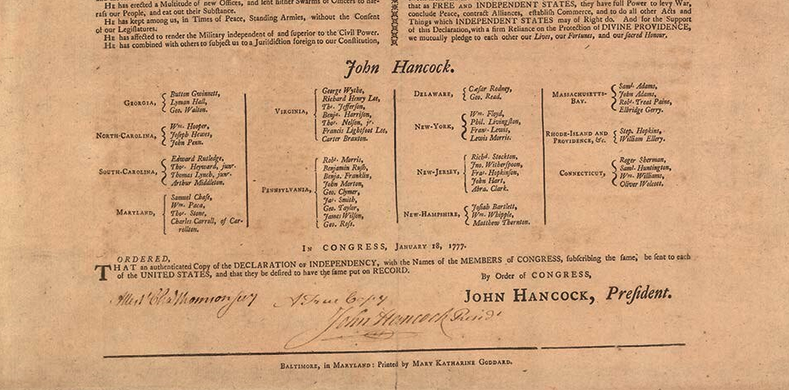
A portion of the lower half of the Mary Katharine Goddard broadside copy of the Declaration of Independence. January 1777.

What Needlework Reveals

Needlework was one domain where colonial women could exercise creativity. Women used it to communicate—samplers included political slogans, mourning pieces commemorated loved ones, and coded messages hid in stitchery during the war. Working within acceptable feminine spheres, women found ways to influence outcomes. They couldn’t vote, but they refused to buy British tea. They couldn’t serve in legislatures, but they managed farms feeding Washington’s army.

The Personal Cost of Public Service

The Revolutionary War demanded sacrifices from women that history often overlooks. Women maintained households, protected children, and kept businesses solvent while managing wartime losses. Their service was essential, yet it brought no political rights. As Berkin writes: “The war for independence allowed, and often propelled, these women to step out of their traditional female roles for the briefest of moments…When the war ended, however, these women returned to their kitchens and parlors—and to the anonymity their society considered feminine.”

Lessons for Today

How do we recognize women’s agency when legal systems denied it existed? How do we properly credit contributions when records were kept in husbands’ names?

These questions matter as we approach America’s 250th anniversary. Accurate history requires acknowledging the full complexity of women’s lives—their constraints and their agency, their sacrifices and their resistance. Women in the American Revolution made choices, took risks, and shaped history—even when the law pretended they didn’t exist.

A Question Worth Pondering for lineage groups: Recognizing Women Patriots

This question of women’s agency has practical implications today for lineage organizations like the Daughters of the American Revolution. Current DAR guidelines state that when a married woman paid supply taxes or furnished aid to the revolutionary cause, patriot recognition goes to her husband because coverture law meant all property belonged to him.

This policy assumes women lacked agency—that they couldn’t make independent decisions about supporting the cause. Yet modern historians like Wulf, Berkin, and others have documented extensive evidence of women’s agency, even within coverture. Women ran businesses in husbands’ absence, made financial decisions, and actively chose to support the revolution.

For a women-centered organization, this presents a question worth pondering. If we recognize that women exercised real agency during the Revolutionary War—managing businesses, making political choices, and taking risks for the cause—should we reconsider how we grant patriot status to married women who demonstrably supported independence, even when legal documents bore only their husbands’ names?


Read the full novel, Carrying Independence, by purchasing an autographed copy. This deep dive focuses on chapter 17 of the novel, in which Susannah is stuck doing needlepoint while her mother outlines her future role as only a married woman. It sets the foundation for her ultimate growth through the freedom that war provided her—a time period in which she gained agency.
Posted in Blog | Comments Off on Women in American Revolution: Agency, Coverture, and the Revolutionary War

Mary House: Recognized as Female Patriot of the American Revolution

During this Women’s History Month, and ahead of the nation’s 250th celebrations, I have the great fortune of announcing a new Revolutionary female Patriot. I spearheaded an application with the National Society Daughters of the American Revolution (NSDAR) to prove a new female American Revolutionary-era Patriot.

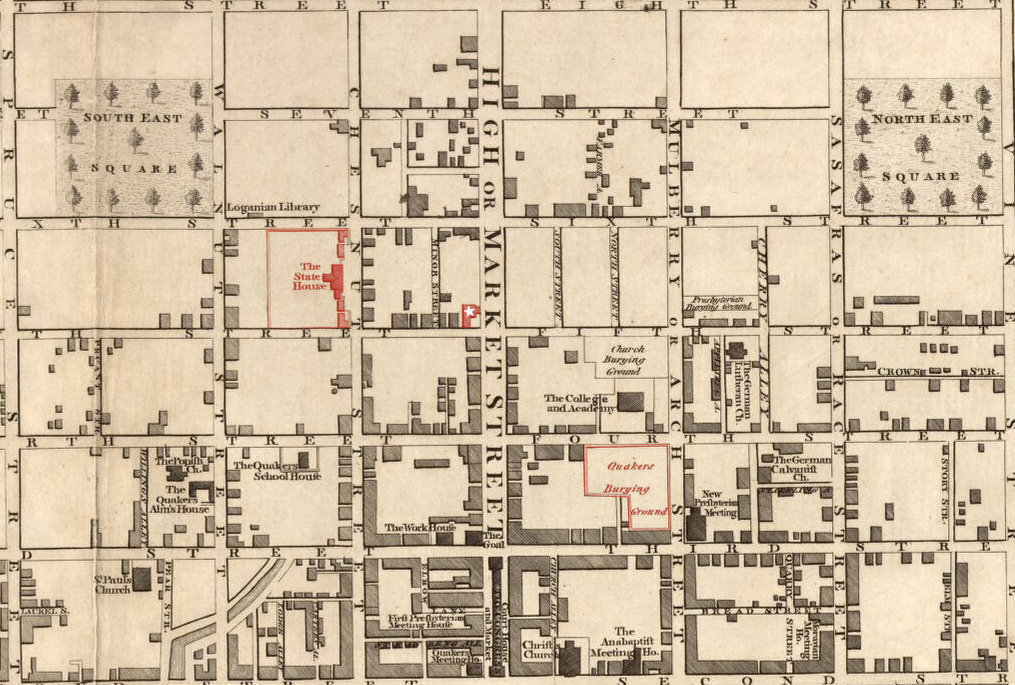
Mary House owned and operated a boarding house in Philadelphia, the House Inn. Because she paid taxes on the inn, her support tax directly helped fund the Revolutionary war. Just two blocks from the famous State House, where Revolution was debated and the Declaration of Independence signed, the inn was a respected political hub, frequented by familiar founding fathers.

In this press release issued by NSDAR, Pamela Wright, NSDAR President General and the National Society’s volunteer elected CEO, says, “We are thrilled to add Mary House to our list of verified female Patriots. As we approach our nation’s 250th birthday, DAR members across the country are concentrating on sharing the stories of these amazing Americans, helping contemporary U.S. citizens understand the relevancy of Patriots to our lives today. As a female entrepreneur myself, I am inspired by the story of Mrs. House.”

The star on this map shows the location of the House Inn. To red outline to the left is the State House. The red outline down and to the right, is the Arch Street Quaker Burial ground where Mary House was buried.

The House Inn hosted Thomas Jefferson and Other Founders

Mary House was a wise entrepreneur. After her husband died, the widow established the boarding house, which quickly became known for what was then called “fine entertainments.” It offered quality lodgings, good food and refreshments, and above all an atmosphere that encouraged convivial engagement. It quickly attracted founding fathers familiar to us now. Silas Deane, James Madison, and Thomas Jefferson. Mary recognized that congressmen visits to Philadelphia would increase as Revolution rumbled through the colonies. Consequently, she wisely moved her already established House Inn closer to the action, to Fifth and Market Streets. Like the famed City Tavern, the House Inn was a gathering place for end-of-day political discourse over dinner and drinks.

Finding Mary House and Proving Her as Patriot

Although I spearheaded the search and the NSDAR application, the journey to validate Mary House’s Patriot status was a collaborative effort. It took multiple years and involved more than 15 individuals across five NSDAR chapters and three states, along with additional historians and translators. To submit an application for patriot status for Mary House, we found and proved lineage to a living descendant. That descendant is also related to two other significant figures: Jefferson and the subject of what I call my Eliza Project.

Mary House’s Daughter, Eliza Trist, Went West & Kept a Journal

Mary House is significant in her own right as a supporter of the Cause and an entrepreneur. She is also the mother of Eliza House Trist—a woman who traveled west in 1783, two decades before Lewis and Clark. Eliza Trist kept this journal for Thomas Jefferson. Trist met Jefferson when he lodged at the House Inn. The two became significant in each others lives, and long after her westward journey, Eliza Trist’s grandson married Thomas Jefferson’s granddaughter. Consequently, this new NSDAR member on this application, is related to House, Trist, and Jefferson.

To be frank, I feel like we’ve hit the NSDAR’s version of a quadfecta or superfecta. Myself, and this incredible network of genealogists and historians, have correctly proven four positions significant to the NSDAR. New female Patriot. New Female Explorer. New member. And all connected to Thomas Jefferson.

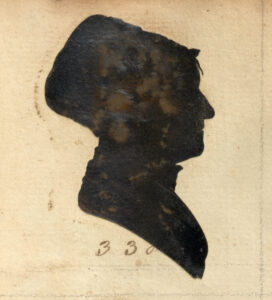
The only known portrait of Eliza House Trist. From the Ledger book of William Bache, National Portrait Gallery.

What will the Patriot Status Achieve?

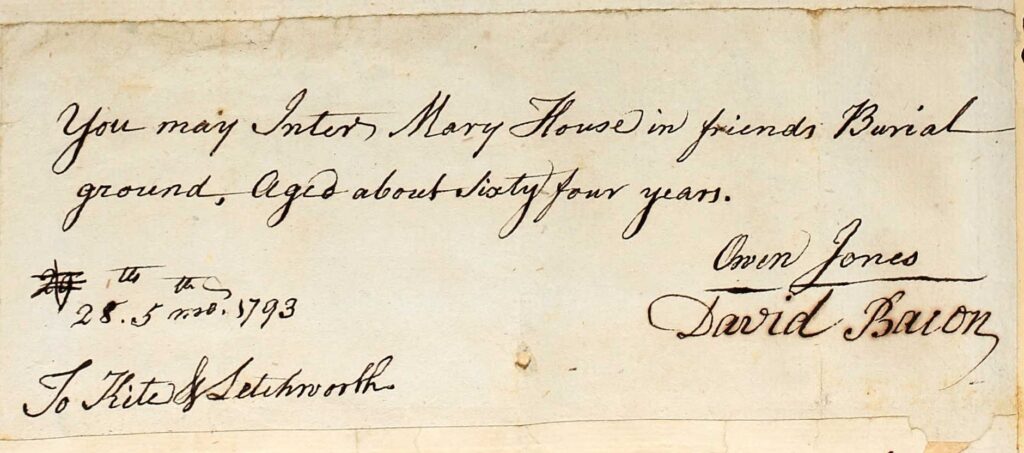
Mary House was buried in Philadelphia, in the Quaker Arch Street burial ground, which was built over in the late 1800s. Eliza Trist is buried at Monticello. Neither woman has a gravestone, and their contributions have never been granted state historical markers. As I mentioned in the press release, “The goal is to ensure each of these women has a grave marker and historical recognition… In honor of the 250th, we are striving to broaden the narrative we tell about the founding of this country. Eliza and Mary matter. Who we tell our origin stories about matters so more of us can envision ourselves contributing to our future.”

The Permission slip provided by the Quakers to bury Mary House in the Arch Street grounds.

To learn more about Eliza House Trist

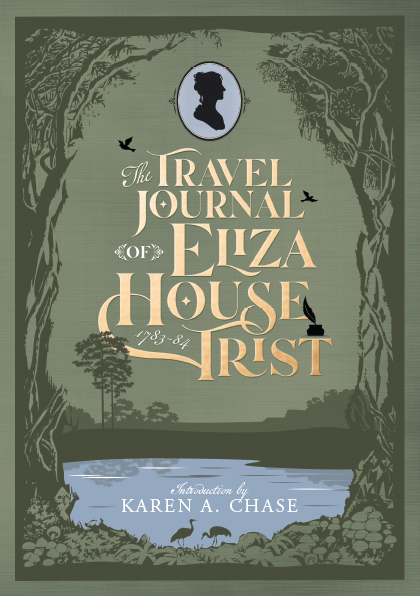
I am producing a more comprehensive and widely-accessible narrative for Mary House and Eliza Trist. For now, you can learn more about Eliza House Trist’s journey when you pre-order a copy of The Travel Journal of Eliza House Trist, 1783-84. It’s a brand new transcription, with a brief introduction. For the first time, her journal is replicated as she originally wrote it. In this beautifully hardbound book, is an all new introduction and a map of her journey. The book publishes April 15th.


Posted in Blog | Comments Off on Mary House: Recognized as Female Patriot of the American Revolution

A Million Daughters

The DAR Million Members Celebration

I am a DAR. As a Daughter of the American Revolution, I can prove my lineage back to a “patriot” who supported the Cause. This fall, I will become one DAR in a million.

Although the DAR currently has about 185,000 active members worldwide, at some point between now and November the DAR will welcome its one millionth member since the organization was founded in 1890. As this milestone comes, I know what such a celebration provides for the future.

What the DAR Millionth Member Means to Me

First, we’ll get to build on the DAR’s (and my) immense love of education and preservation. Scholarships, grants, and school support for boys and girls come from the DAR. Without the DAR, the Block House at Fort Pitt, PA and the Custom House at Yorktown, VA might not be standing. They are just two examples of historic places the women and chapters of our organization saved, own, and maintain.

Secondly, we are moving into the future as an inclusive organization. It is not religion, politics, or race that define who we are, and this openness fits with who I am. Gone is the privileged DAR featured in movies or shows like the Gilmore Girls. This new DAR is made up of welcoming career women, moms, students, and everyday women who are eager to contribute and get things done.

By comparison, the Sons of the American Revolution has about 35,000 active members. So make no mistake, it’s women getting it done. And soon, we’ll be a million strong.

If you think you might be a DAR, contact a local chapter (search here by zip code) and ask for the Registrar or Membership Chair. They’ll help you with an application. And check out our Facebook Page filled with Million Member Testimonials.

DAR_564

. . . . . . . . . . . . . . . . . . . . . . . . . . . . . .

Reader Insights: I became a DAR while researching my novel, CARRYING INDEPENDENCE. In my travels for research, I kept finding markers at historical sites and upon graves revitalized by DAR chapters. So in addition to researching the book, I researched my own lineage. Although I am Canadian, it was Jacob G. Klock of New York who I proved to be my ancestral patriot. Who is yours?

. . . . . . . . . . . . . . . . . . . . . . . . . . . . . .

For more history nerd posts like these, subscribe to the blog. Guest posts are welcomed and encouraged. Contact me for details.

For behind-the-scenes author-related news, giveaways, and to find out where I might be speaking near you, subscribe to my e-publication, CHASING HISTORIES.


Posted in Blog | Comments Off on A Million Daughters

Delaware State Society DAR – Fall Conference

A presentation to the Delaware State Society, Daughters of the American Revolution at their Fall State Conference. Program is “Carrying Independence,” the stories behind the book and the document. RSVP of members, please contact your chapter for details.

Commonwealth Chapter NSDAR Luncheon

Author presentation to my own Commonwealth Chapter, at their October meeting, followed by a luncheon. Luncheon RSVP required. Members and guests welcome.

© 2024 Karen A. Chase. Collection of data from this website is GDPR compliant, and any information you may have about data collection can be found in our privacy policy.